





Why Large Interior Branding Projects Fail
Large-format interior branding is unforgiving. What works on a small feature wall often fails when applied at much larger scale.
Scale amplifies every weakness. Minor alignment issues become obvious. Inconsistent tension shows immediately. Installation inefficiencies multiply into delays and cost overruns.
Understanding where projects go wrong is the first step toward avoiding expensive mistakes.
Underestimating Wall Conditions and Structure
The wall itself is the most underestimated variable in large interior installations.
Walls are often assumed to be flat, plumb, and structurally uniform. In real commercial environments, this is rarely true. Concrete walls can wave. Drywall can flex. Stud spacing may be inconsistent.
Load-bearing considerations are frequently overlooked. Large-format fabric systems distribute weight across many mounting points. Without proper assessment, installers are forced to improvise, increasing labor and alignment risk.
Fire-rated assemblies, embedded utilities, or restricted anchoring zones can further limit mounting options if not identified early.
Incorrect Frame Depth and Profile Selection
Frame selection mistakes become more expensive as wall size increases.
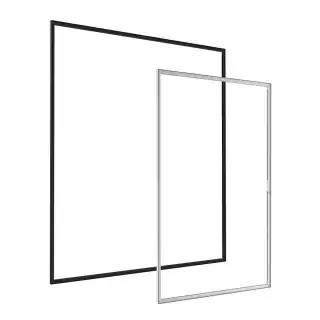
Shallow profiles are often chosen to reduce cost or minimize visual depth. On large walls, shallow frames offer less rigidity and tolerance, increasing the risk of bowing and uneven reveals.
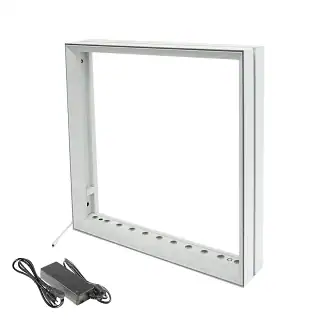
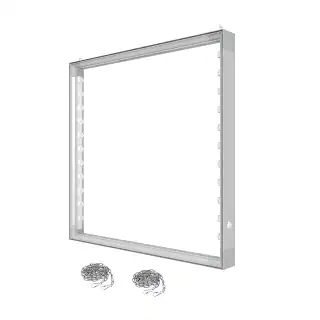
Deeper profiles provide added stiffness and forgiveness. They help bridge wall irregularities and support integrated lighting where required.
Choosing frame depth without considering span length and wall condition is one of the most common planning errors.
Poor Fabric and Graphic Specifications
Fabric choices that work on small applications often fail on large surfaces.
High-stretch fabrics make installation easier but soften image detail and increase the risk of long-term sagging. Low-stretch fabrics preserve sharpness but require precise sizing and finishing.
Color consistency is another challenge. Large installations often require multiple panels. Without strict color management, subtle shifts become visible once panels are installed side by side.
Graphics that rely on perfect continuity across seams leave no margin for real-world tolerances.
Installation Access and Logistics Overlooked
Large installations require construction-level planning.
Ceiling height, lift access, and floor load limits all affect how efficiently an installation can proceed. These constraints are often identified too late.
Equipment repositioning, restricted access, or occupied spaces increase installation time and risk.
When logistics are underestimated, rushed installs lead to visible defects that are difficult to correct.
Budget Miscalculations and Hidden Costs for SEG Wall Projects
Budgets for large interior branding projects often focus too narrowly on materials.
Installation labor increases nonlinearly with size. More footage means more alignment checks and more adjustment time, particularly on a SEG Wall installation.
Reprints are costly at scale. Inadequate proofing or inaccurate sizing can trigger expensive late-stage corrections.
Long-term maintenance, including graphic updates and retensioning, should be considered during planning.










 5101 Commerce Dr., Baldwin Park, CA 91706
 ExhibitorLive 2026 , Mar 30-April 1, Tampa , FL , Booth #237